UK Government Finances: The Big Picture an Actuary Would Want to See
by Patrick Lee on 16 Mar 2026 in categories actuarial pensions with tags AI economics productivityThe UK government published its latest Whole of Government Accounts in July 2025. It's 318 pages long, consolidates over 10,000 public sector bodies, and — for the second year running — the Auditor General refused to sign it off. The National Audit Office disclaimed its opinion entirely: 201 entities didn't submit data, 280 used unaudited figures. The government's own auditor is saying: we can't tell you whether these numbers are right.
That should trouble anyone who reads accounts for a living. And yet these are the most comprehensive financial statements we have for the entire UK public sector. They're the closest thing to a corporate annual report for the country.
I used AI tools to extract and cross-reference data from the 2023-24 WGA, OBR forecasts, and HMRC statistics, then verified the key figures against the original sources. Here's what I think any actuary — or any numerate taxpayer — would want to know. This is the first in a series applying actuarial and accounting thinking to public finances. No politics. Just the numbers.
The COVID shadow
It's impossible to read these accounts without understanding what happened in 2020-21. The government's pandemic response — furlough, business support loans, NHS surge capacity, Universal Credit uplift, vaccine procurement — was the largest peacetime fiscal intervention in UK history. Borrowing hit £299bn in a single year (14.8% of GDP). Net debt jumped from around 80% of GDP to over 95%, where it remains. The WGA balance sheet swelled: total liabilities peaked at £6.3 trillion in 2021-22, inflated by pandemic borrowing and ultra-low discount rates on pension obligations.
The 2023-24 WGA captures the aftermath. The emergency spending has ended, but the structural consequences — higher debt, higher interest costs, expanded welfare claims — are now embedded in the baseline. The numbers you're about to read are post-COVID numbers. They are the new normal.
Revenue: three taxes fund two-thirds of the state
Total public services revenue in the year to 31 March 2024 was £1,019.9bn. Of that, £888.8bn was taxation and £131.1bn was other revenue (fees, interest income, NHS charges, rents, and so on).
Here's how the tax breaks down:
| Tax | £bn | % of total |
|---|---|---|
| Income Tax | 286.2 | 32.2% |
| VAT | 165.5 | 18.6% |
| National Insurance Contributions | 157.6 | 17.7% |
| Corporation Tax | 89.6 | 10.1% |
| Excise Duty | 33.9 | 3.8% |
| Hydrocarbon oils duty | 24.9 | 2.8% |
| Council Tax | 28.5 | 3.2% |
| Business rates | 26.3 | 3.0% |
| Stamp taxes | 16.1 | 1.8% |
| Capital Gains Tax | 14.3 | 1.6% |
| Other | 45.9 | 5.2% |
| Total | 888.8 | 100% |
The top three taxes — Income Tax, VAT, and NICs — brought in £609.3bn. That's 69% of all taxation from just three instruments. Everything else — corporation tax, council tax, business rates, stamp duty, CGT, fuel duty, excise — combined produces just 31%.
This concentration matters. It means the Treasury is heavily exposed to the labour market. If employment falls or wage growth stalls, the majority of revenue is directly hit. The OBR's ready reckoners put this in concrete terms: a 1% fall in average earnings would reduce income tax receipts by £3.5bn and NICs by £2.8bn — a combined £6.3bn hit, roughly the entire annual inheritance tax yield, wiped out by a single percentage point of wage weakness.
Central government collects 94% of all taxation (£834.0bn). Local government collects just 6% (£54.8bn) — council tax and business rates. The centralisation of UK tax collection is extreme by international standards.
The people behind the numbers
Before looking at where the money goes, it's worth understanding who's doing what. The UK population (mid-2024, ONS: 69.3 million) breaks down roughly as follows:
| Group | Millions | % of total |
|---|---|---|
| Children (0-15) | ~12 | 17% |
| Working age (16-64) | ~43 | 62% |
| Pension age (65+) | ~14 | 20% |
| Total | 69.3 |
Of the 43 million working-age adults, 34.2 million are in employment (2025) and 9.4 million are economically inactive — not in work and not looking for work. Against the working population, 13.1 million people receive the state pension. In total, 24 million people claim at least one DWP benefit, though many of those are also employed (Universal Credit, for example, tops up low wages).
The ONS breaks down the reasons for working-age inactivity, and the time series tells a striking story:
| Year | Long-term sick (000s) | Students (000s) | Looking after family (000s, F) | Retired early (000s) | Total inactive (000s) |
|---|---|---|---|---|---|
| 2010 | 2,226 | 2,274 | 2,126 | 1,540 | 9,446 |
| 2015 | 2,074 | 2,306 | 2,022 | 1,228 | 9,037 |
| 2019 | 2,046 | 2,295 | 1,782 | 1,116 | 8,644 |
| 2024 | 2,802 | 2,511 | 1,438 | 1,083 | 9,378 |
Long-term sickness has risen from 2.0 million to 2.8 million since 2019 — a 37% increase. It is now the single largest reason for working-age economic inactivity, overtaking students. This is the biggest structural shift in the post-COVID labour market, and it feeds directly into disability benefit costs (projected to rise from £39bn to £58bn by 2028-29).
Two other trends are worth noting. The number of women inactive due to looking after family has nearly halved since 1993 (from 2.9 million to 1.4 million) — a massive structural shift as more women entered the workforce. And early retirement among the working-age population peaked at 1.56 million in 2011 but has since fallen to 1.03 million, driven by the increase in state pension age from 60 to 66 for women and 65 to 66 for men.
The dependency arithmetic is simple: 13.1 million state pensioners supported by 34.2 million workers gives a ratio of roughly one pensioner for every 2.6 workers. That ratio will worsen as the baby boomer cohort retires and working-age population growth slows.
The migration variable
Net migration is the single biggest swing factor in this picture. It peaked at 944,000 in the year to March 2023 — driven by post-COVID catch-up, Ukraine and Hong Kong schemes, and a surge in health and care worker visas. It has since fallen sharply to 204,000 in the year to June 2025, back to roughly pre-pandemic levels.
The OBR's fiscal forecasts are highly sensitive to these numbers. In its March 2026 outlook, the OBR estimates that each year's net migrants contribute around £19,500 per person in tax revenue. Over its five-year forecast, the central migration assumption (settling at around 315,000 per year) adds £6.2bn to annual tax receipts by 2028-29 and reduces borrowing by £7.4bn. A swing of 200,000 per year in either direction would change borrowing by £13-20bn — comparable to the entire annual budget of some government departments.
The fiscal impact depends heavily on who is migrating. The OBR's average figure of £19,500 per migrant in tax revenue reflects a mix of high-earning professionals, students, care workers, dependants, and refugees — groups with very different fiscal profiles. A migrant arriving at age 25 and earning UK average wages until retirement would contribute a net £341,000 over their lifetime, according to OBR modelling. But that is an idealised scenario. Research from the Migration Observatory at Oxford shows that EEA migrants have historically made a positive net fiscal contribution, while non-EEA migrants — who now dominate UK immigration flows — tend to have a smaller or negative fiscal impact on average, largely because of lower average earnings and higher use of public services including education for dependant children.
The post-2020 surge was heavily non-EEA: students, health and care workers (many on relatively low salaries), dependants, and asylum seekers. Two specific humanitarian schemes account for a significant share: around 210,000 Ukrainians arrived under the Ukraine visa schemes by mid-2024, and approximately 163,000 Hong Kongers arrived under the BN(O) visa route by March 2025. These are distinct from the broader asylum system, where not all claims are upheld — the initial grant rate for asylum claims was 67% in 2023 but fell to 47% in 2024 under the higher standard of proof required by the Nationality and Borders Act, meaning that roughly half of claimants are not granted protection. None of the ONS net migration figures above include illegal immigration. The most visible route — small boat Channel crossings — totalled around 29,000 in 2023 and 37,000 in 2024, but this is only part of the picture. Others enter clandestinely via lorries and trains, or arrive legally and overstay their visas. The government does not publish an estimate of the total unauthorised population. Academic estimates from 2017 — before the small boat crossings proliferated — put it at 700,000 to 1.2 million (Pew Research Centre). Since then, around 175,000 unauthorised arrivals were recorded between 2020 and September 2024 alone, and roughly 85,000 refused asylum seekers from 2010-2023 have not been recorded as having left the UK. A reasonable current estimate of the total unauthorised population is probably somewhere above one million, though the true figure is inherently uncertain. This composition is likely less fiscally positive than the OBR's blended average implies. And the fiscal benefit of any cohort erodes over time as migrants settle, bring family, and eventually retire — at which point they draw on the same pensions and health services as everyone else. If public services spending adjusts to reflect a larger population (more school places, GP appointments, housing), the OBR estimates this would cost an additional £6-8bn — partially offsetting the tax gains.
The political direction is towards lower migration — higher salary thresholds, tighter visa rules, and a stated aim to reduce dependence on overseas workers. For the fiscal arithmetic, this creates a genuine tension: fewer working-age taxpayers entering the system at precisely the point when the baby boomer retirement wave is accelerating, but also potentially lower pressure on public services and housing. The net effect depends on whether the migrants who do come are higher-earning (as the salary threshold policy intends) or whether total numbers fall faster than average quality rises.
Expenditure: the two elephants in the room
Total expenditure on public services in the year to 31 March 2024 was £1,076.3bn, giving a net operating deficit of £56.4bn. Here's where it went:
| Category | £bn | % of total |
|---|---|---|
| Social security benefits | 311.4 | 28.9% |
| Purchase of goods and services (see below) | 263.7 | 24.5% |
| Staff costs | 240.5 | 22.3% |
| Grants and subsidies | 104.1 | 9.7% |
| Depreciation and impairment | 64.2 | 6.0% |
| Interest on government borrowing | 63.4 | 5.9% |
| Increase in provisions | 29.0 | 2.7% |
| Total | 1,076.3 | 100% |
Social security benefits (£311.4bn) deserve a closer look, because this is where the real money is:
| Benefit | £bn | % |
|---|---|---|
| State pension | 127.3 | 40.9% |
| Universal Credit | 53.1 | 17.1%* |
| Personal Independence Payment | 23.2 | 7.5% |
| Tax credits | 19.4 | 6.2% |
| Employment and Support Allowance | 13.4 | 4.3% |
| Child Benefit | 12.5 | 4.0% |
| Housing Benefit | 11.9 | 3.8% |
| Pension credit | 5.7 | 1.8% |
| All other benefits | 45.0 | 14.4% |
| Total | 311.4 | 100% |
*Universal Credit spiked to £80.4bn in 2020-21 at the height of the pandemic (temporary uplift + mass unemployment claims) before falling back and then rising again as legacy benefits migrate onto UC. The current £53.1bn reflects UC's growing share — 63% of combined UC and legacy benefit spending — as legacy benefits are wound down. By 2028-29, the OBR forecasts UC alone will reach £88.1bn.
The state pension alone — £127.3bn — is larger than the entire defence budget. Pensioner benefits collectively (including pension credit) total £133.0bn, or 43% of all social security spending. Working-age and disability benefits account for the other 57%.
The purchase of goods and services figure (£263.7bn) is worth unpacking, because at first glance it's surprising that it exceeds staff costs. This is the government's total non-staff operational spending — drugs and medical supplies, IT services, outsourced clinical and support services, equipment, maintenance, consumables, rent, utilities, and contracted-out services. The WGA Note 8 breakdown by department shows where it goes:
| Department | £bn |
|---|---|
| Health and Social Care | 93.3 |
| Ministry of Defence | 25.0 |
| Scottish Government | 11.2 |
| Academy schools | 9.2 |
| Department for Transport | 9.1 |
| Home Office | 7.4 |
| Local government | 66.8 |
| Other | 41.7 |
| Total | 263.7 |
Health dominates — the DHSC spent £93.3bn on procurement alone, more than Defence, Scottish Government, and academies combined. This reflects the NHS's enormous outsourcing footprint: agency staff (classified as procurement, not staff costs), pharmaceutical purchases, PFI service charges, and contracted clinical services.
When you combine the functional spending view (from HM Treasury's COFOG classification), the picture is even starker:
| Function | £bn | % |
|---|---|---|
| Social protection | 378.3 | 33% |
| Health | 230.2 | 20% |
| Education | 118.4 | 10% |
| General public services | 169.9 | 15% |
| Everything else | 259.3 | 22% |
Social protection and health together account for 53% of all government spending. These are the two elephants. Everything else the government does — defence, policing, courts, transport, housing, environment, culture — fits in the remaining 47%.
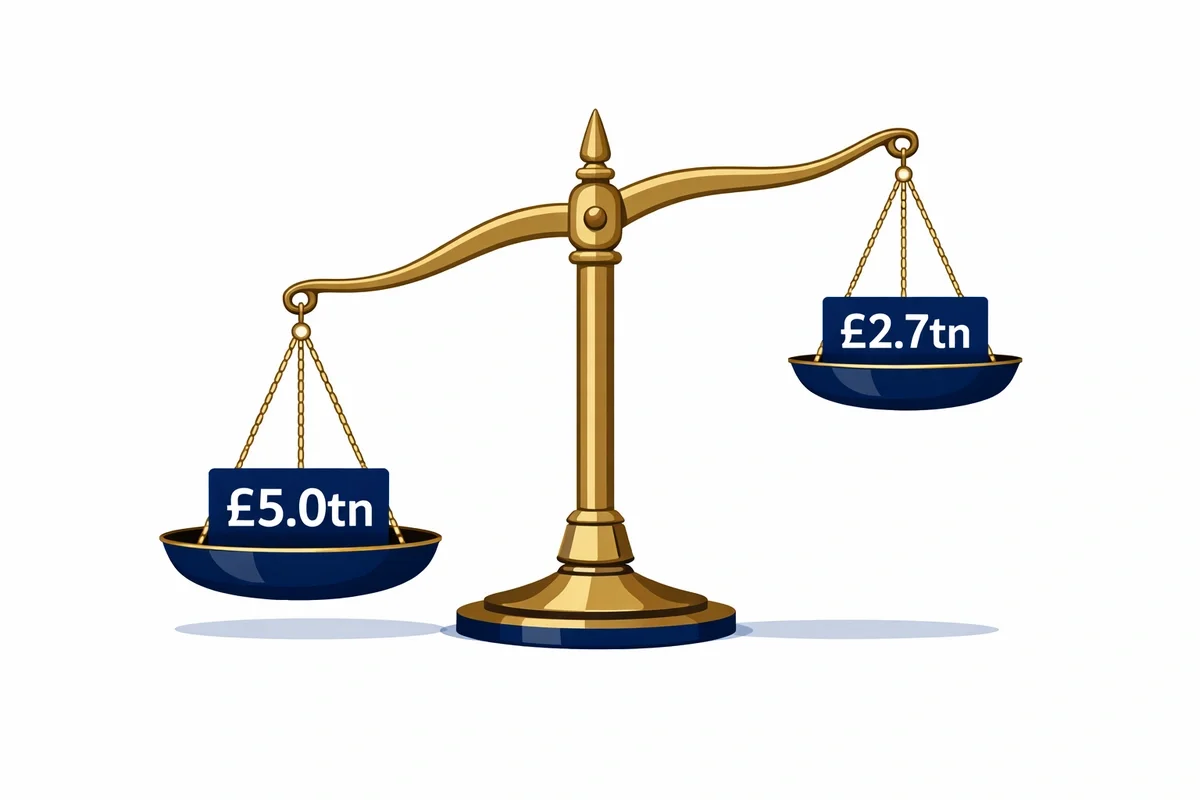
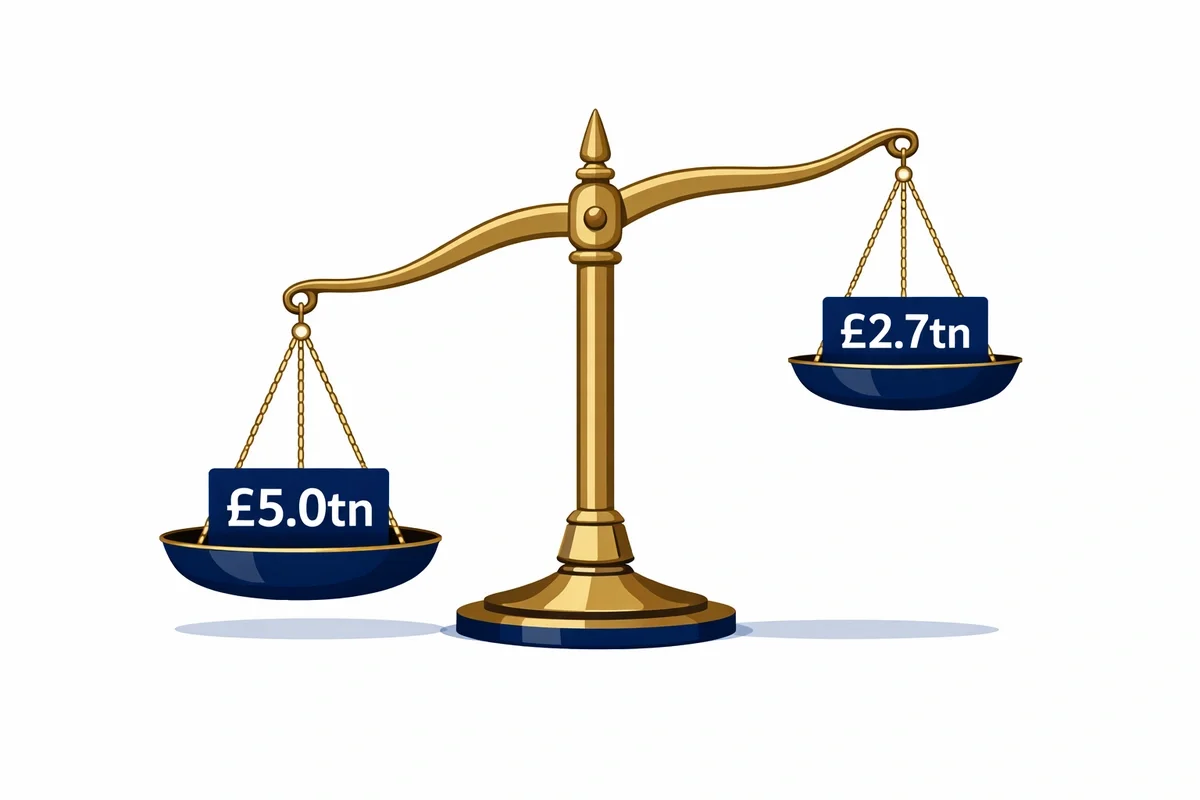
The balance sheet: £5 trillion of liabilities
The WGA consolidates a full accruals-based balance sheet as at 31 March 2024 — something the headline fiscal statistics (debt-to-GDP, borrowing) don't capture. This is where it gets interesting for actuaries.
Assets: £2,651.3bn (31 March 2024)
| Asset | £bn |
|---|---|
| Property, plant and equipment | 1,539.1 |
| Financial assets (non-current) | 470.0 |
| Financial assets (current) | 237.6 |
| Trade and other receivables | 239.1 |
| Intangible assets | 52.1 |
| Cash | 39.5 |
| Other (right-of-use, gold, inventories etc.) | 73.9 |
| Total | 2,651.3 |
PP&E dominates — £1.5 trillion of roads, hospitals, schools, military equipment, social housing. Most of it is illiquid and non-tradeable. The government couldn't sell the M1 to plug a budget gap.
The gold holdings (£17.5bn) are a footnote — a reminder of Gordon Brown's sale of 395 tonnes at prices between $256 and $296 per ounce. At March 2024 prices (~$2,200/oz), the remaining 310 tonnes are worth roughly £17.5bn. The 395 tonnes sold would today be worth approximately £22bn.
Liabilities: £5,024.5bn (31 March 2024)
| Liability | £bn |
|---|---|
| Government borrowings (gilts, NS&I, T-bills) | 2,020.0 |
| Net pension liabilities | 1,311.9 |
| Other financial liabilities | 1,202.1 |
| Provisions | 262.2 |
| Trade and other payables | 228.3 |
| Total | 5,024.5 |
Net liabilities: £2,373.2bn — roughly £34,900 per person in the UK.
Government borrowings (£2,020.0bn) and pensions (£1,311.9bn) together are £3,331.9bn — two-thirds of all liabilities. The borrowings comprise gilts (£1,703.4bn carrying amount, split between £1,613.0bn non-current and £90.4bn current), NS&I products (£230.5bn), and Treasury bills (£86.1bn).
An accountant would note the fair value gap on the gilts: fair value is £1,463.1bn versus the carrying amount (book value) of £1,703.4bn. Fair value here is essentially market value — what the gilts would trade for in the open market given current yields. The book value is the amortised cost — roughly the face value the government must ultimately repay. The £240bn difference reflects above-market coupon rates on older issuances — the government is paying more interest than it would on today's borrowings, but the face value obligation remains.
Provisions: £262.2bn
The provisions note is where the long-tail liabilities live — and this is directly actuarial territory:
| Provision | £bn |
|---|---|
| Nuclear decommissioning | 106.9 |
| Clinical negligence (England) | 58.2 |
| Pension Protection Fund | 19.1 |
| EU liabilities | 10.6 |
| MOD nuclear | 9.0 |
| Nuclear Liabilities Fund | 9.6 |
| Oil & gas decommissioning | 5.7 |
| Clinical negligence (Scotland + Wales) | 2.9 |
| Total | 262.2 |
Nuclear decommissioning (£106.9bn) is one of the longest-tail liabilities in existence — stretching decades into the future, with cost estimates sensitive to discount rates, technology assumptions, and real cost inflation. Clinical negligence (£61.1bn across the UK) is growing rapidly and represents the NHS's hidden balance sheet problem.
The PFI legacy
Then there's PFI — the Private Finance Initiative. Between the 1990s and 2018, the government used PFI to build hospitals, schools, prisons, and roads using private sector capital. The idea was simple: the private sector builds and maintains the asset, the government pays an annual "unitary charge" over 25-30 years, and the risk sits with the contractor. The programme was discontinued in 2018, but 665 contracts are still running, with the last ones not expiring until 2048.
The WGA puts these on the balance sheet (Note 28). The net book value of PFI assets is £68.9bn. The corresponding liability — the present value of future capital repayments — is £35.9bn. But that's only the capital element. The total future commitments break down as follows:
| Future PFI obligations | £bn |
|---|---|
| Finance lease (capital + interest) | 55.3 |
| Annual service charges | 58.1 |
| Total future PFI commitments | 113.4 |
HM Treasury's own 2024 summary data puts it slightly differently: £136bn in remaining unitary charge payments across the 665 projects, against a capital value of around £50bn.
The NAO's 2018 analysis was blunter. It found that PFI financing was around 40% more expensive than government borrowing for the same assets. Across the entire PFI portfolio, total lifetime repayments were estimated at roughly £300bn — for assets with a capital value of £57bn. That's a multiplier of over 5x.
The NHS is the most exposed. The Department of Health and Social Care holds £17.3bn of PFI finance obligations and £20.2bn of future service charges. There are 121 hospital PFI projects in England alone, with a combined capital cost of £11.6bn and estimated total repayments of £79.3bn. Individual cases are striking: Barts Health NHS Trust in London has a 43-year PFI contract for buildings worth approximately £1.1bn, with total repayments exceeding £7bn.
What makes PFI particularly interesting from an accounting perspective is the gap between how it appears in different sets of government accounts. In the WGA — which follows IFRS — most PFI assets and liabilities are on the balance sheet, because the government is deemed to control the asset. In the National Accounts — which politicians and the media cite — most PFI is off the balance sheet, because the private sector bears the risks and rewards. The WGA reconciliation shows £31bn of PFI contracts that appear in WGA but not in the headline public sector net financial liabilities. When politicians talk about "the national debt," they're using the number that excludes most of this.
140 of the 665 projects expire before 2030. The Infrastructure and Projects Authority recommends starting to plan for contract expiry at least seven years in advance. Many are already inside that window.
The pension iceberg
This is the section I find most interesting as an actuary. The WGA breaks down public sector pension liabilities by scheme (as at 31 March 2024), and the numbers are enormous:
| Scheme | Net liability (£bn) | Change from 31 Mar 2023 |
|---|---|---|
| NHS | 500.8 | -6.4% |
| Teachers | 307.8 | -8.0% |
| Civil Service | 208.1 | -6.0% |
| Armed Forces | 144.6 | -7.6% |
| Police | 93.9 | -9.8% |
| Royal Mail (pre-privatisation) | 28.7 | -4.0% |
| Fire | 17.6 | -22.1% |
| Other unfunded | 14.4 | 0.0% |
| Total unfunded | 1,315.9 | -7.2% |
| LGPS (funded — 98 funds) | (2.8) | — |
| Other funded | (1.2) | — |
| Grand total (net) | 1,311.9 | -7.3% |
These are almost entirely unfunded defined benefit occupational pensions — entirely separate from the state pension (which costs £127.3bn and appears in the social security benefits line above). There are no invested assets backing these schemes. Current employees and employers make contributions, current pensioners receive payments, and the gap is plugged by taxation. In 2023-24, total contributions to these unfunded schemes were £49.9bn and payments to pensioners were £55.0bn — a £5.1bn annual shortfall that taxpayers cover. (The WGA is published annually, typically 15 months after the year-end. The 2024-25 figures — as at 31 March 2025 — would be expected around mid-to-late 2026.)
The four largest schemes — NHS, Teachers, Civil Service, and Armed Forces — account for £1,161.3bn, or 88% of the total unfunded liability.
The discount rate illusion
Anyone who has worked with IAS 19 disclosures will immediately recognise what happened here. In my previous analysis of 12 FTSE companies' pension disclosures, the same dynamic played out at corporate level — but the government version is 100x larger.
| Year (31 March) | Discount rate | Net pension liabilities (£bn) |
|---|---|---|
| 2022 | ~1.5% | 2,639 |
| 2023 | 4.15% | 1,415 |
| 2024 | 5.10% | 1,312 |
Between 2022 and 2024, pension liabilities fell by £1,327bn — more than half. But the underlying pension promises are identical. No pensions were cut. No retirement ages were raised. No benefits were reduced. The only thing that changed was the discount rate used to value them.
A 3.6 percentage point rise in gilt yields halved the present value of future pension payments. If yields were to fall back to 2022 levels — which is not impossible in a recession — the liabilities would balloon back towards £2.6 trillion.
This is the single most important thing an actuary can explain about public finances: the numbers that politicians and commentators cite are extraordinarily sensitive to a single market variable that nobody controls and nobody can predict.
For unfunded government pensions, the real cash cost each year is what matters — contributions in versus pensions out. The present value is an accounting number. But that accounting number is what drives the WGA balance sheet, and it's what the headlines report. So when the Treasury points to "improving" net liabilities, it's worth asking: did anything actually change, or did the discount rate do the work?
The trend: 15 years of WGA data
The WGA has been published annually since 2009-10, giving us a 15-year picture:
| Year | Total assets (£bn) | Total liabilities (£bn) | Net liabilities (£bn) | Net pensions (£bn) |
|---|---|---|---|---|
| 2009-10 | 1,207.5 | 2,419.3 | ~1,212 | 1,132 |
| 2016-17 | 1,903.0 | 4,323.7 | ~2,421 | 1,835 |
| 2021-22 | 2,414.3 | 6,289.2 | 3,874.9 | 2,639 |
| 2022-23 | 2,554.3 | 4,943.4 | 2,389.1 | 1,415 |
| 2023-24 | 2,651.3 | 5,024.5 | 2,373.2 | 1,312 |
Total assets have more than doubled (£1,208bn to £2,651bn). But liabilities have also more than doubled (£2,419bn to £5,025bn). The gap has roughly doubled too — from ~£1.2 trillion to ~£2.4 trillion.
The 2021-22 peak of £3.9 trillion in net liabilities was the combined effect of two forces: pandemic-era borrowing (which pushed government debt sharply higher) and ultra-low interest rates (which inflated pension liabilities to £2.6 trillion at a discount rate of ~1.5%). The subsequent "improvement" to £2.4 trillion was driven almost entirely by the discount rate rise — not by any reduction in spending commitments. Strip out the pension remeasurement, and the underlying fiscal position deteriorated: government borrowings rose from £1,754bn to £2,020bn between 2022-23 and 2023-24 alone, as the pandemic-era debt was rolled over at higher interest rates.
What's coming next
The OBR's March 2026 Economic and Fiscal Outlook projects borrowing of £133bn in 2025-26, falling to £59bn by 2030-31. Net debt is expected to peak at 96.5% of GDP in 2028-29 before stabilising.
But some of the spending pressures are baked in. The state pension triple lock guarantees minimum annual increases of 2.5%, earnings growth, or CPI — whichever is highest. State pension spending is already £127.3bn and growing faster than revenue. Disability benefits are projected to rise from £39bn to £58bn in five years. Debt interest — £63.4bn in the WGA, but forecast at £114bn for 2025-26 by the OBR — is now larger than the defence budget and growing. Much of this is the direct cost of pandemic borrowing: gilts issued at low yields in 2020-21 are being refinanced at rates two to three times higher, and index-linked gilts — roughly a quarter of the stock — amplified the cost when inflation surged in 2022-23.
Meanwhile, the personal allowance has been frozen at £12,570 since 2021-22 and won't rise until at least April 2031. A decade of fiscal drag, pulling millions of low earners into the tax base and pushing middle earners into higher bands. It's a stealth tax that compounds silently — and it's the government's main mechanism for closing the gap.
The tax-to-GDP ratio is forecast to reach 38% by 2030-31 — a post-war high.
If this were a household
Economists will tell you that a government is not a household. A household can't raise taxes, print its own currency, or live forever. All true. But the household analogy is useful as a stress test — not because the government is a household, but because the traditional reasons why it doesn't have to behave like one are becoming less convincing.
Let's scale it down. The UK government's finances in 2023-24, expressed as a household earning £50,000 a year:
| Government (£bn) | Household equivalent (£) | |
|---|---|---|
| Income | 1,019.9 | £50,000 |
| Spending | 1,076.3 | £52,770 |
| Annual shortfall | 56.4 | £2,770 |
| Outstanding debt | 2,020.0 | £99,030 |
| Unfunded pension promises | 1,311.9 | £64,310 |
| Other liabilities (provisions, payables, etc.) | 1,692.6 | £82,970 |
| Total liabilities | 5,024.5 | £246,310 |
| Assets (mostly the house) | 2,651.3 | £129,970 |
| Net debt | 2,373.2 | £116,340 |
| Annual interest payments | 63.4 | £3,110 |
In terms a mortgage adviser would understand:
-
The mortgage (gilts — £99,000): A mortgage of roughly 2x income — modest by UK standards, where many households borrow 4-5x income. On its own, this would be very manageable. But here's what makes it unusual: the mortgage is less than half of this household's total liabilities. Most households have a mortgage and not much else. This one has a mortgage and a pension gap, and an overdraft, and repair bills, and a hire purchase contract. And it's adding to the mortgage every year — borrowing another £2,770 annually just to cover day-to-day expenses, which is like putting the weekly shop on the mortgage.
-
The pension gap (unfunded schemes — £64,000): This household has promised itself a defined benefit pension but has put nothing aside to pay for it. It's as if you'd committed to paying yourself £2,700 a year in retirement, relying entirely on your children to cover it when the time comes. And the time is already here — the payments have started and contributions don't quite cover them.
-
The other debts (other financial liabilities, provisions, payables — £83,000): This is a mix. The largest chunk (£59,000) is like an enormous overdraft facility that the household arranged during a crisis and hasn't unwound — the equivalent of the Bank of England's QE reserves sitting on the balance sheet. Buried within that overdraft is a hire purchase agreement (PFI: £1,800 on the balance sheet, but £5,600 in total future payments) where you're paying five times the asset's value over 25 years and can't get out of the contract. Then there's £13,000 of known future repair bills — the roof needs replacing (nuclear decommissioning: £107bn), there's a growing legal claim from a neighbour (clinical negligence: £61bn), and various other commitments that can't be avoided. And £11,000 in unpaid bills sitting on the kitchen table.
-
The interest bill (£3,110 a year): That's 6.2% of income going on servicing debt — more than half what the household spends on its children's education (£5,800). And it's rising — the old fixed-rate deals are expiring and being replaced at rates two to three times higher. The OBR forecasts this rising to over £5,600 by 2025-26.
-
The house (assets — £130,000): Mostly property, roads, and equipment. Theoretically worth £130,000, but almost none of it can be sold. You can't liquidate a hospital or auction off the M1 to pay down debt.
Add it all up and this household has £246,000 in liabilities against £130,000 in unsellable assets, is spending more than it earns every month, and has no realistic plan to pay down the balance. A financial adviser would call this unsustainable. The traditional response is that governments have three escape routes that households don't:
1. Raise taxes. But the tax-to-GDP ratio is already heading for a post-war high of 38%. The personal allowance has been frozen for a decade. National Insurance was raised in 2022 and employer NICs again in 2025. At some point, higher taxes reduce economic activity and the revenue gains diminish — the Laffer curve is real even if nobody agrees where the peak is. Capital and talent are more mobile than ever: raise corporation tax too far and investment moves; raise personal tax too far and high earners relocate. The headroom is shrinking.
2. Print money (monetary financing). The Bank of England effectively did this during COVID through quantitative easing — buying £450bn of gilts with newly created reserves. The 2022-23 inflation surge was primarily driven by energy prices (Russia's invasion of Ukraine sent gas prices soaring) and global supply chain disruptions, but QE created the inflationary backdrop: an economy flooded with liquidity was far more susceptible to price shocks when they arrived. The combined result — CPI hitting 11.1% in October 2022 — eroded real wages, inflated index-linked gilt costs, and forced emergency rate rises. The lesson is fresh: monetary financing may not directly cause inflation, but it removes the buffer that would have contained it. Whether that lesson prevents it being used again is another matter — governments under fiscal pressure have historically found reasons to revisit tools they once swore off.
3. Grow your way out. This is the only genuinely sustainable route — if real GDP growth exceeds the real interest rate on government debt, the debt-to-GDP ratio falls naturally over time. But the OBR's central forecast is for real growth of 1.1-1.6% per year through 2030. Gilt yields are around 4.5%. The arithmetic only works if growth accelerates substantially or yields fall back — neither of which is guaranteed.
There is a fourth factor that rarely features in these discussions: AI and automation. If AI delivers even a fraction of its projected productivity gains, it could transform the fiscal equation — higher output per worker, new industries, expanded tax base. But it could equally hollow out the traditional employment model that generates 69% of all tax revenue (income tax + NICs + VAT on consumption). If millions of jobs are automated faster than new ones are created, the government faces lower tax receipts and higher welfare costs simultaneously. Nobody knows which effect will dominate, but the risk is asymmetric: the upside accrues gradually over decades, while the labour market disruption could arrive in years.
The honest assessment is this: the UK's fiscal position is not yet a crisis, but the margin of safety has narrowed dramatically. Government debt is 198% of annual revenue — nearly two years' income. Interest costs consumed 6.2% of revenue in 2023-24, and the OBR forecasts this rising to over 11% by 2025-26 as pandemic-era gilts are refinanced at higher rates. The major spending categories — pensions, health, disability — are all structurally growing faster than revenue. Every traditional fiscal lever has already been partially used. And the next recession — whenever it comes — will hit a balance sheet with far less capacity to absorb the shock than in 2008 or 2020.
A household in this position would be told to cut spending, increase income, or both — urgently. A government has more tools, but fewer than it used to, and the cost of each tool is higher than it was a decade ago.
Why this matters for actuaries
Actuaries value long-term liabilities for a living. We understand that a discount rate is not a magic wand — it changes the present value, not the cash flows. We know that unfunded promises are real obligations even when they don't appear on a conventional balance sheet. We're trained to stress-test assumptions and ask what happens when they're wrong.
The WGA is the single most actuarially relevant document the UK government publishes, and almost nobody reads it. Not politicians, not journalists, and — based on the NAO's audit disclaimer — not even all the public bodies that are supposed to contribute to it.
In the next post in this series, I'll go deeper into the pension liabilities — how the six unfunded schemes compare, what the cash flow projections look like, and what longevity risk means when there's no corporate sponsor and the bill falls directly on future taxpayers.
All figures in this post are from the Whole of Government Accounts 2023-24 (HC 917, published 17 July 2025), the OBR March 2026 Economic and Fiscal Outlook, and OBR tax-by-tax spend-by-spend briefings. The WGA received a disclaimed audit opinion from the Comptroller and Auditor General for the second consecutive year. Full source links are available on request.
Patrick Lee is the founder of INQA Group. He is a qualified actuary — MA FIA (1990 to Sep 2020) Dip Stats — and a software architect.